

Jenny Saville on Rembrandt
I have always thought that serious art is not just something put into the world by its makers to express their feeling or point of view or as a reaction to some external stimulus. It’s also in conversation with work made in the past, sometimes reluctantly, sometimes in spite of the artist’s intention. To a greater or lesser extent, all works of art join a continuum that stretches back to prehistory.
The OCA acknowledges this through the inclusion of ‘context’ as part of its assessment criteria. Students are expected to find out about the territory in which they work and to be articulate when writing or talking about the work of others. Art is not made or understood in isolation.
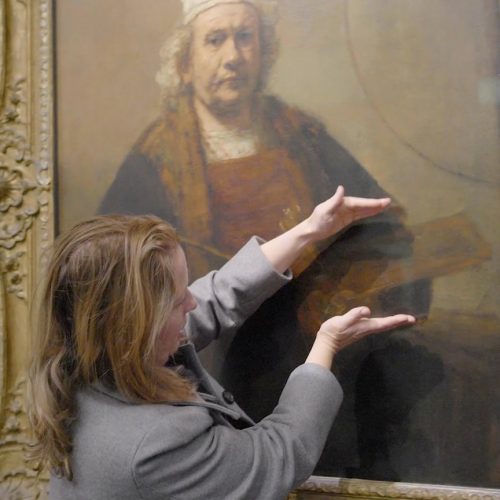
Look at this short film of Jenny Saville talking about what she gets from a single self-portrait by Rembrandt.
https://gagosian.com/quarterly/2019/05/15/video-interview-jenny-saville-rembrandt-self-portrait/
It has to be remembered that this is a great painting and its richness is part of its greatness. Don’t be under the impression that every painting is such a gateway. But let’s deal with what Saville speaks about.
She explains how she has learned specific things from looking at the painting – how to paint a nose, for instance – but also more subtle things like the tension between figuration and abstraction. She also sees Rothko in the work. That might seem fanciful, but why not? Looking hard reveals stuff and making connections is important.
Standing in front of a painting like this one it is clear – and Saville talks about this – that Rembrandt has used lots of different ways to put paint on the canvas. Big marks, small ones, quick, slow, and scratches made with the handle of the brush. In other work (perhaps even in this one, he used his thumb to drag paint across the canvas). That liveliness and invention keeps the eye moving; decoding and interpreting as it goes. Saville’s own work is dense with colour and gesture and in places – as explained here – at odds with reality (whatever that is). Paintings like these aren’t made in a single way. In the Rembrandt there are thin, barely sketched parts, and others that are thick and oily. From what Saville says, she got that variety – ‘turning up the volume’ – from immersing herself in Rembrandt.
In terms of contextual understanding, she clearly identifies how Bacon drew on Rembrandt (and Velasquez) and, by implication, places herself in that mix. It’s not difficult to link Rembrandt to Rubens and Caravaggio and both of them to Michelangelo. So now we have a short chain that starts with Michelangelo and ends with Jenny Saville. That’s context.
It’s a short film that contains much. I tell students (and I’m sure you’ve all heard this form someone) that you should embrace and learn from the work of others and forget about being ‘original’. If you’re lucky, you’ll get there, but I think you’ll only do that by talking to experts. We might not be able to speak to Rembrandt (or Beethoven, or Shakespeare), but we can listen to them through their work, and the work we make can – kind of – speak back.
Featured image: https://gagosian.com/quarterly/2019/05/15/video-interview-jenny-saville-rembrandt-self-portrait/
 |
> Next Post Breaking into the boys’ club
< Previous Post Join the new OCA Book Group!
Drawing Department 2023 Assessment Showcase
8 Comments
As Programme Leader for the BA (Hons) Drawing Degree I am really pleased to...
Read more
Tutor News – Katrina Whitehead
6 Comments
Some of you will know me as your personal tutor, or you may have...
Read more
OCA News: Creative Arts Update
0 Comments
The Creative Arts Programme Leader, Doug Burton, will leave the OCA in November after...
Read more
Creative Arts Showcase 2023
2 Comments
The Creative Arts Showcase is now in its third year and is an end...
Read more